
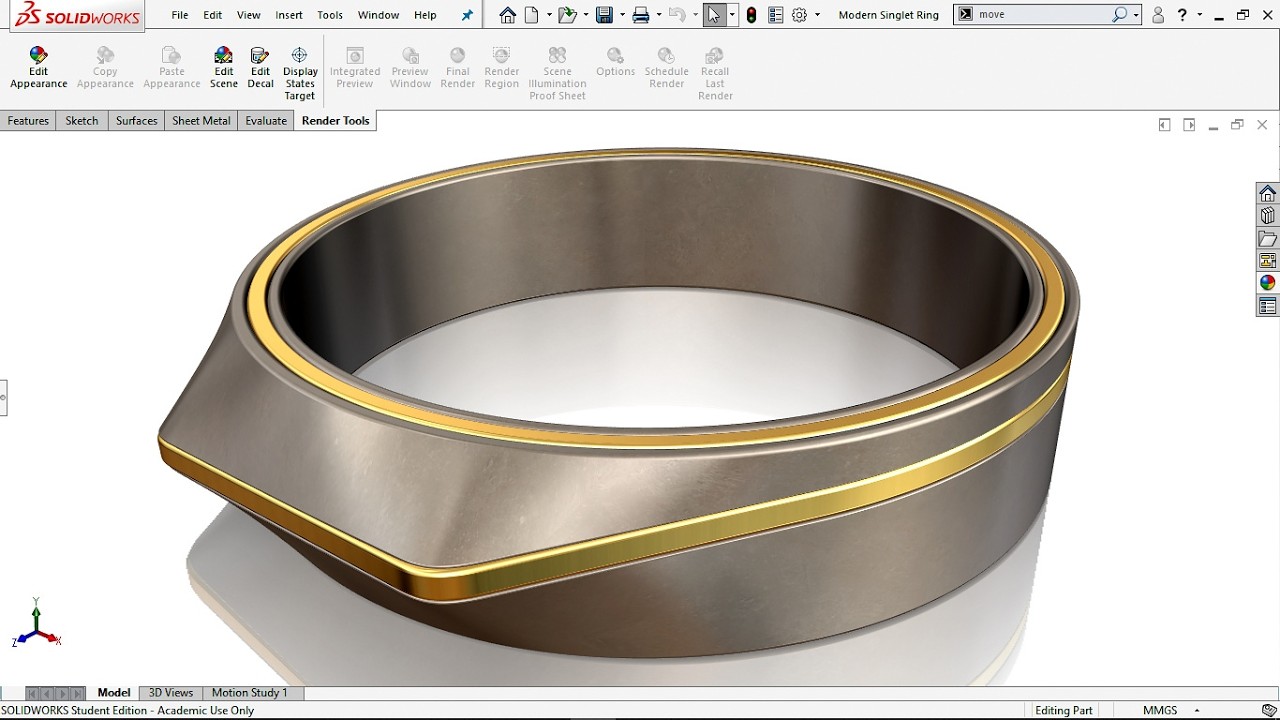
In modern mechanical engineering and industrial design, mastering complex 3D CAD modeling techniques is essential for creating reliable, high-performance, and manufacturable components. Computer-Aided Design serves as the foundational core of contemporary product development, enabling engineers to build parametric geometry, perform stress analysis, and optimize dynamic assemblies long before physical prototypes are manufactured. This video presentation offers an in-depth exploration of advanced modeling workflows, emphasizing precise geometric constraints, accurate dimensional tolerances, and high-efficiency design practices designed to meet rigorous modern manufacturing standards.
Technical Overview & Core Design Principles
The technical framework demonstrated in this project focuses on robust feature tree management, precise surface continuity, and structural durability. Beginning with foundational two-dimensional sketches, the design utilizes precise geometric relations—such as tangency, concentricity, and symmetric constraints—to ensure that dynamic modifications can be implemented without triggering feature breakages down the design tree. As the model expands into three-dimensional space, key operations like swept extrusions, lofted cuts, and variable-radius fillets are strategically applied to distribute operational loads evenly across critical stress points.
Furthermore, careful attention is directed toward tolerance stack-up analysis and surface clearance for mating components within complex assemblies. By incorporating proper draft angles, uniform wall thicknesses, and optimized corner radii, the model fully aligns with real-world manufacturing constraints, including CNC precision machining, plastic injection molding, and direct metal additive manufacturing.
Key Features and Design Highlights
- Parametric Feature Tree Optimization: Structured using clean, editable sketch relationships and optimized feature hierarchies for seamless modification and design iteration.
- Precision Mechanical Tolerances: Formulated with exact clearance fits to ensure zero interference during dynamic motion simulation and functional assembly testing.
- Structural Integrity & Ergonomics: Integrates smooth curvature-continuous blends and reinforced rib structures to maximize strength-to-weight ratios under heavy stress loads.
- Design for Manufacturability (DFM): Engineered in compliance with standard production workflows, significantly reducing machining setup times and raw material waste.
Practical Applications and Industry Relevance
The CAD modeling techniques and design methodologies showcased in this video hold significant practical value across a broad spectrum of engineering fields. In aerospace and automotive sectors, similar parametric workflows are routinely implemented to design lightweight structural brackets, custom mechanical linkages, and protective enclosures that must endure high vibration and severe thermal conditions. Adopting these refined CAD practices leads to faster design cycles, lower prototyping expenses, and overall higher production quality.
Additionally, hardware engineers and robotics developers can adapt these workflows for rapid prototyping and custom enclosure design. By maintaining accurate digital twin representations, engineering teams can perform early-stage Finite Element Analysis (FEA) and Computational Fluid Dynamics (CFD), ensuring that physical components perform flawlessly under real-world operational environments.


