
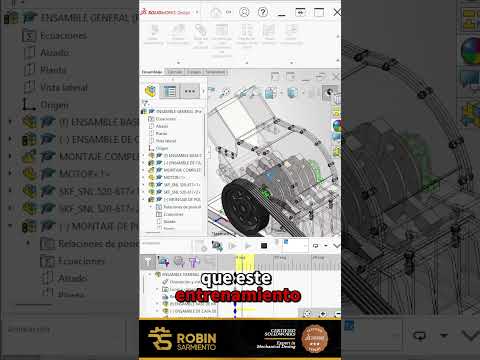
Are you trying to learn SolidWorks by memorizing individual tools and buttons? Many aspiring engineers and designers fall into the trap of studying modeling, assemblies, and animations as isolated islands of knowledge. While you might learn how to extrude a boss or create a mate, you may still feel lost when faced with a complex, real-world project. To truly master the software, you need more than just a list of features; you need a clear, structured roadmap.
The Problem with Tool-Based Learning
The biggest challenge for beginners is the lack of "design intent." When you learn tools separately, you miss the bigger picture of how a project flows from a simple sketch to a functional assembly. You might know how to use the "Revolve" tool, but do you know when it is more efficient than a "Sweep"? Without a clear route, you spend more time troubleshooting your feature tree than actually innovating.
Transitioning from Modeling to Assembly
A professional workflow in SolidWorks requires a deep understanding of how parts interact. A structured learning path teaches you how to build parts with the assembly in mind. This "top-down" or "bottom-up" logic ensures that when you change a single dimension in a sketch, your entire assembly updates without errors. This level of proficiency only comes when you stop looking at tools in isolation and start looking at the design process as a unified system.
Beyond the Basics: Animation and Simulation
Once you have mastered the geometry, the next step is validation. Learning how to animate your assemblies or run basic simulations is vital for presenting your ideas to clients or supervisors. However, these advanced features rely heavily on how well your initial models were built. By following a clear learning route, you ensure that your foundations are rock-solid, making advanced tasks like motion study and rendering much more intuitive.
Conclusion: Finding Your Clear Route
To become a proficient designer, you must shift your focus from "what" a tool does to "how" it fits into a professional workflow. By following a strategic path, you will gain the confidence to tackle any engineering challenge. Mastering SolidWorks is not about knowing every single button; it is about knowing the most efficient way to bring your ideas to life. Stop wandering through disconnected tutorials and start following a roadmap that leads to professional success.


