
Introduction to Mechanical Component Design
If you are looking to elevate your mechanical design skills, mastering SolidWorks is essential for creating precise, production-ready components. Among the various industrial parts every designer should learn, the bearing bracket is a fundamental example. It combines basic geometric sketching with key 3D feature creation, making it an ideal practice project for both beginners and intermediate CAD users.
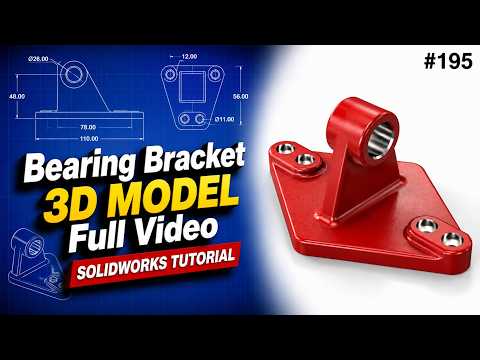
In this guide, inspired by the Needful3D video tutorial, we will walk through the professional step-by-step process of building a 195 Bearing Bracket from the ground up.
Key Steps to Model the 195 Bearing Bracket
Creating an industrial bracket requires a structured approach to maintain fully defined sketches and parametric flexibility.
1. Establishing the Base Profile
Begin by selecting the main reference plane and sketching the base footprint of the bracket. Focus on defining precise dimensions for the mounting slot positions and outer dimensions, as these features determine how the part integrates into a larger mechanical assembly.
2. Building the Central Housing and Features
Once the base is extruded to the correct thickness, create the central cylindrical housing intended to hold the bearing assembly. By effectively using core features in SolidWorks, such as extruded bosses, hole wizards, and rib tools, you can ensure the part retains structural integrity while minimizing unnecessary material.
3. Adding Fillets and Manufacturing Details
With the primary geometry established, refine the design by adding fillets, chamfers, and counterbores. These technical details not only give the model a polished appearance but also represent real-world manufacturing practices by reducing stress concentrations.
Why This Tutorial Matters for CAD Developers
Working on real-world mechanical models like the 195 Bearing Bracket provides an excellent opportunity to refine your SolidWorks workflow. Learning how to organize feature trees and maintain clean geometry will significantly enhance your modeling speed and accuracy.
Whether you are building your engineering portfolio or preparing for CAD certification, practicing structured modeling techniques ensures your designs are accurate and ready for production. Watch the complete video tutorial to follow along step-by-step and upgrade your design capabilities today!


