
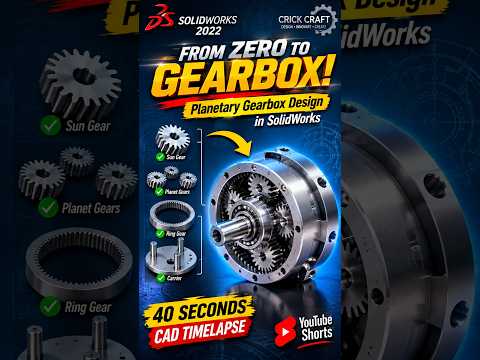
In the world of mechanical engineering, few components are as satisfying to design and assemble as a planetary gearbox. It is a masterpiece of precision, power transmission, and efficiency. Whether you are a student or a professional engineer, moving from a blank canvas to a high-performance mechanical assembly is a journey that requires the right tools. This is where the power of SolidWorks 3D modeling truly shines, allowing creators to turn complex concepts into functional digital prototypes.
The Foundation of Gear Design
Designing a gearbox from scratch—often called the "Zero to Hero" approach—begins with understanding the mathematical relationship between gears. In a planetary system, you have the sun gear, the planet gears, and the outer ring gear. Precision is non-negotiable; even a fraction of a millimeter in error can lead to mechanical failure. By utilizing SolidWorks 3D modeling, designers can automate gear tooth profiles and ensure that every component meshes perfectly before a single part is ever manufactured.
From Sketch to Assembly
The process starts with a 2D sketch, defining the pitch circles and pressure angles. Once the basic geometry is established, we extrude these shapes into 3D space. The beauty of modern CAD software is the ability to apply "Mates" and constraints. This allows you to simulate the actual movement of the gearbox. Watching the gears rotate in a digital environment provides immediate feedback on the gear ratio and mechanical clearance.
Furthermore, SolidWorks 3D modeling enables engineers to perform stress tests and motion analysis. You can identify potential weak points in the gear teeth or the housing, allowing for rapid iterations. This "fail fast" mentality in the digital world saves thousands of dollars in physical prototyping and manufacturing costs.
Bridging CAD and Manufacturing
The final stage of the "Zero to Hero" journey is preparing your design for the real world. Whether you plan to use CNC machining or 3D printing, having a high-fidelity 3D model is essential. A well-constructed CAD file serves as the blueprint for the entire manufacturing process, ensuring that the "craft" of engineering remains precise from the screen to the shop floor.
Engineering is more than just drawing lines; it is about solving problems through spatial reasoning and logic. By mastering these design techniques, you transform from a beginner into a creator capable of building the machinery of the future.


